Apartment Decorating on a Budget: 18 Ideas That Look Aesthetic
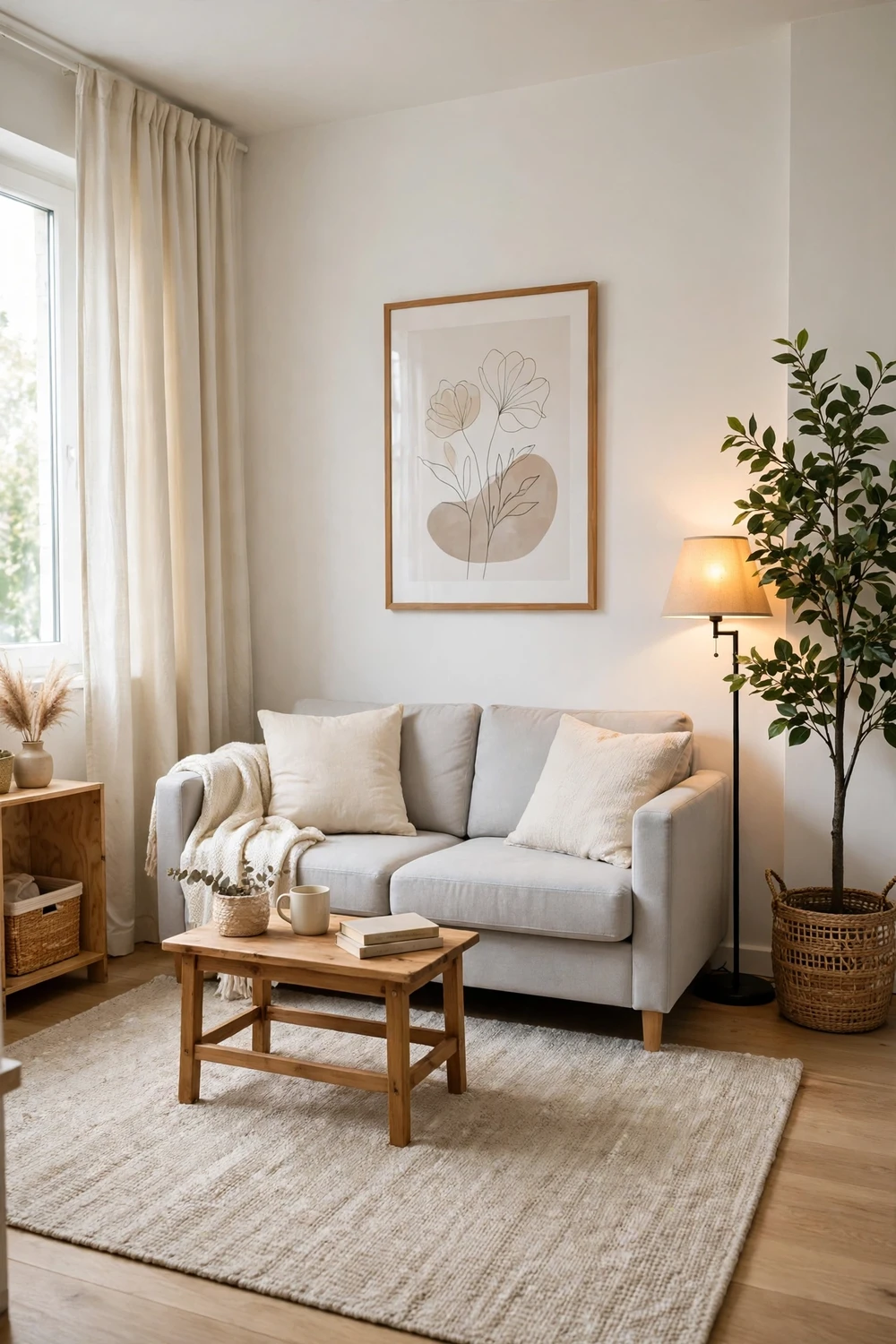
Affordable Aesthetic Ideas for Small Spaces
Most apartment decorating advice hands you a long list of pretty things to buy and no idea what to spend in total. You buy a cushion here, a frame there, a rug that turns out too small, and the apartment still looks unfinished. This article does it the other way round. This is apartment decorating on a budget as a whole apartment plan: pick a total first, then spend it in a set order, with a price on every idea and a running total you can check as you go.
Three totals cover almost every renter: $150 for a fresh start built on the biggest changes, $300 for a full apartment that looks finished, and $500 for the full plan plus the extras that make it feel like a home. Every idea below costs under $50, and the first three cost nothing at all.
One more thing before the plan. This article covers the plan itself: the order, the prices and the layout. The warm, personal layer lives in our deep dive on warm and personalized apartment ideas. Read that one after this plan, and use it to add the personal touches on top of the structure you build here.
Apartment decorating on a budget: pick your total first
A plan works only if the numbers add up, so here is the whole plan in one table. Each idea has a typical price range, a plan price, and a running total. The plan price is the middle of the range. Prices are typical ranges for thrift, budget and online shopping, not exact store prices, and they will vary where you live.
| Idea | Typically costs | Plan price | Running total |
|---|---|---|---|
| 1. Measure, tape and declutter | $0 | $0 | $0 |
| 2. Rearrange and zone with what you own | $0 | $0 | $0 |
| 3. Pick one three colour palette and one style | $0 | $0 | $0 |
| 4. Warm white bulbs and low light | $10 to $18 | $14 | $14 |
| 5. Curtains hung high and wide | $18 to $35 | $26 | $40 |
| 6. One rug big enough to zone the room | $30 to $48 | $39 | $79 |
| 7. One large art piece in a thrifted frame | $8 to $20 | $14 | $93 |
| 8. Lean a large mirror opposite the window | $25 to $45 | $35 | $128 |
| 9. Peel and stick accent on one small area | $12 to $25 | $18 | $146 |
| 10. Cushion covers only, the 2+1 formula | $12 to $24 | $18 | $164 |
| 11. Layer three textures per room | $15 to $30 | $22 | $186 |
| 12. Hotel style bed plus one duvet cover | $20 to $40 | $30 | $216 |
| 13. One multifunctional piece | $30 to $48 | $39 | $255 |
| 14. Go vertical with tall narrow shelves | $20 to $40 | $30 | $285 |
| 15. One thrifted wood anchor plus hardware swap | $25 to $45 | $35 | $320 |
| 16. Kitchen: clear counters and decanting | $8 to $18 | $13 | $333 |
| 17. Bathroom: shower curtain and towels | $15 to $30 | $22 | $355 |
| 18. Entryway: lean mirror and tray drop zone | $12 to $25 | $18 | $373 |
The three tiers follow the table in order.
The $150 tier: ideas 1 to 9, plan total $146. This is the fresh start: the free changes, the light, the curtains, the rug and the walls. Stop here and the apartment already looks deliberate.
The $300 tier: ideas 1 to 14, plan total $285. This is the full apartment: it adds the textiles, the bed and the first furniture pieces. This is the tier most renters should aim for.
The $500 tier: all 18 ideas plus five extras, plan total $500. The 18 ideas come to $373. The extras below bring the total to exactly $500.
| Extra | Typically costs | Plan price | Running total |
|---|---|---|---|
| Second rug for the bedroom | $30 to $48 | $40 | $413 |
| One more large art piece | $12 to $28 | $20 | $433 |
| Second cushion cover set | $12 to $24 | $18 | $451 |
| One statement lamp | $20 to $40 | $30 | $481 |
| Three plants with pots | $12 to $25 | $19 | $500 |
Other guides that cost this out land in the same place: one puts a small apartment budget at $200 to $1,000 with under $50 per item as a common cap, another totals a full small apartment at $400 to $450, and a third breaks down a $480 plan.
Buy in this order and do not skip ahead. Do ideas 1 to 3 first, because they cost nothing and they decide what you actually need. Then buy ideas 4 to 9, the $150 tier, then ideas 10 to 14, the $300 tier, then ideas 15 to 18 and the extras, the $500 tier.
Start with the layout, not the shopping
Small apartments are not decorated, they are arranged. Before you buy anything, walk the room and find where you actually stand, sit and walk. Measure the room and the furniture you already own, then tape the outline of each piece on the floor. Leave about 75 to 90 cm of clear walkway wherever you pass every day. If the tape shows a route that squeezes past a chair, move the chair, not the tape.
Float the sofa off the wall. In a small room the instinct is to push everything to the wall to make space, but it does the opposite: it leaves a dead middle and makes the walls look crowded. Pull the sofa out even 15 cm and put a floor lamp behind one end. Use the rug and the light to mark zones instead of walls: the rug marks the sitting zone, a lamp marks the reading corner, the table marks the eating zone. Awkward corners are where a tall plant, a narrow shelf or a floor lamp belongs.
Do this layout work before you spend a dollar, because it tells you the sizes you need. A rug bought before you tape the layout is usually the wrong size, and curtains bought before you measure the window are usually too short. The tape costs nothing and it saves the most expensive mistake in this whole article.
For 25 living room only ideas that go deeper on this room, see our small living room ideas on a budget. The plan below keeps the living room to the ideas that matter most.
Group 1: Before you spend anything
These three ideas are free, and they do more than any purchase in this article.
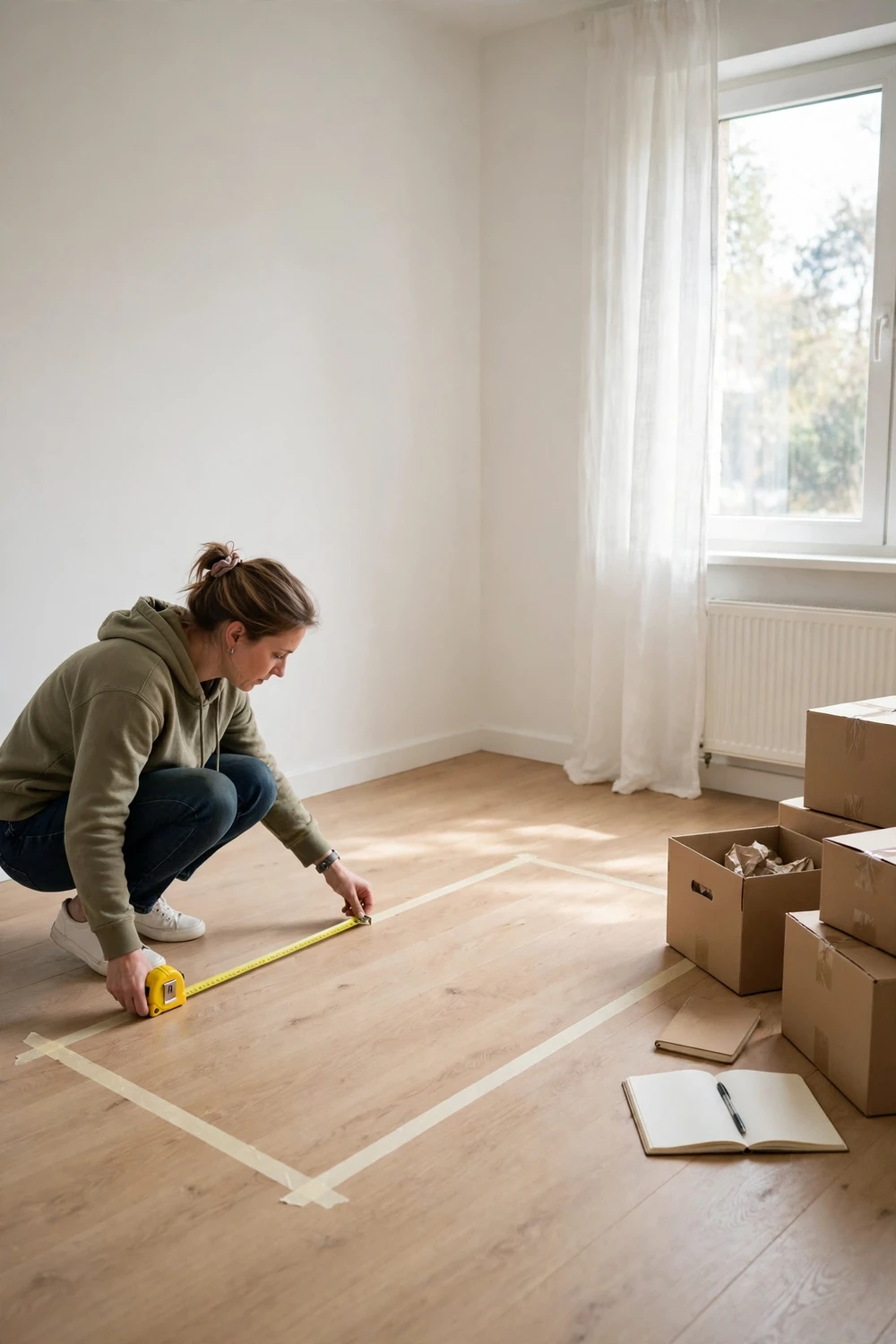
1. Measure, tape the layout, and declutter first
Measure the room, the windows and the furniture you already own, and write the numbers down. Then tape the outline of the sofa, the table and the bed on the floor and walk around the tape for a day. You will find the tight spots and the corner you never use, before you spend anything.
Then declutter. Take everything out of one room at a time, and keep only what you use or love. A good rule is to remove one thing in every three: one of the three vases, one of the three throws, one of the three small frames. Small apartments look cluttered long before they look empty. Bag the rest for donation the same day.
Typically $0. Plan price $0. Running total $0.
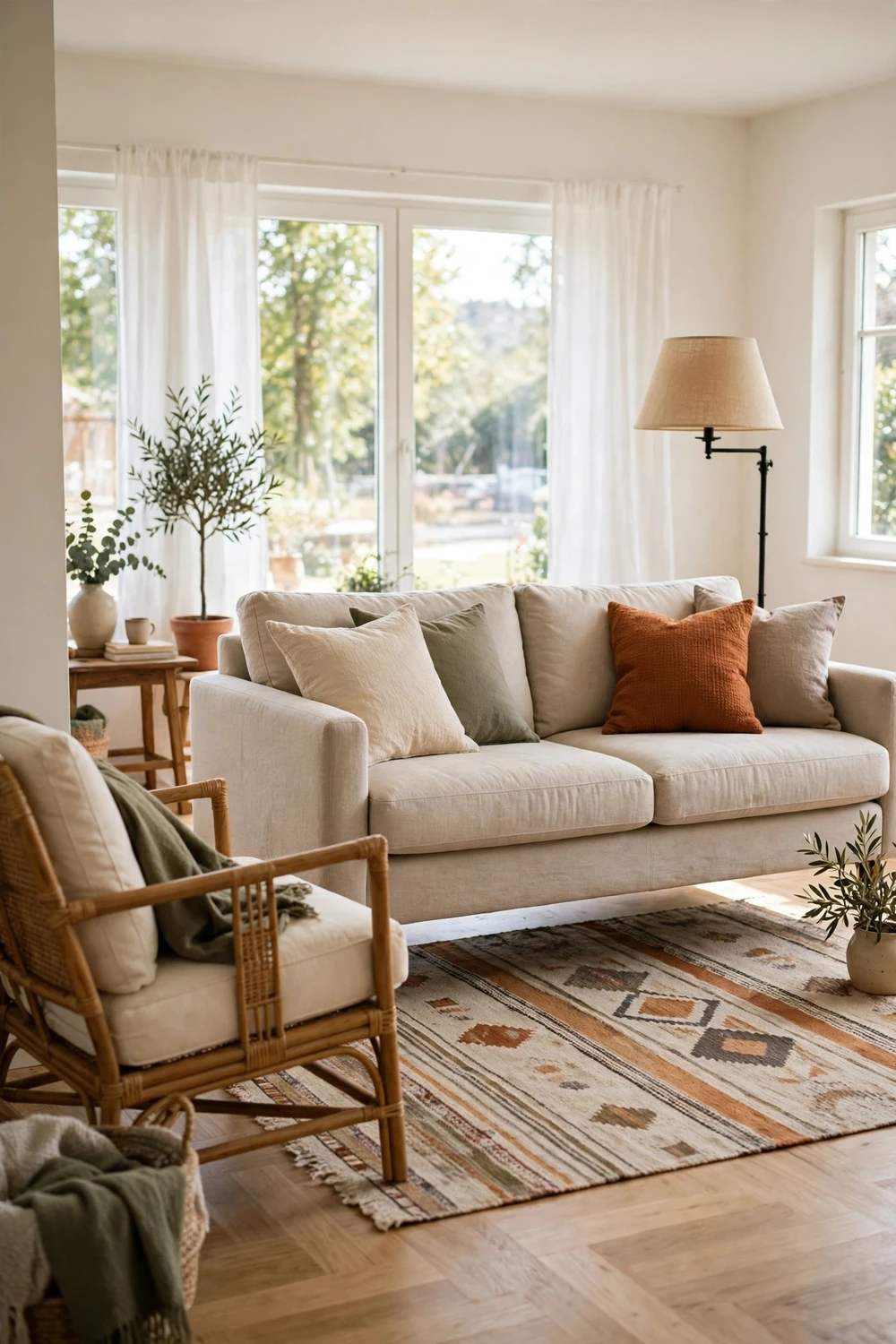
2. Rearrange, float the sofa, and zone with what you own
Move the furniture before you buy furniture. Float the sofa off the wall and face it toward the window or the television, whichever the room is really for. Angle one chair toward the sofa instead of lining every seat up against a wall. Put the reading chair where the afternoon light is best.
Zone with what you already own. The rug marks the sitting zone, a floor lamp marks the reading corner, and the dining table marks the eating zone, even in one open room. If two zones blur together, a low bookcase turned sideways makes a soft divider that still lets light through. Try the new arrangement for two evenings. Rearranging is free, and it is the fastest way to find out what the room actually needs.
Typically $0. Plan price $0. Running total $0.
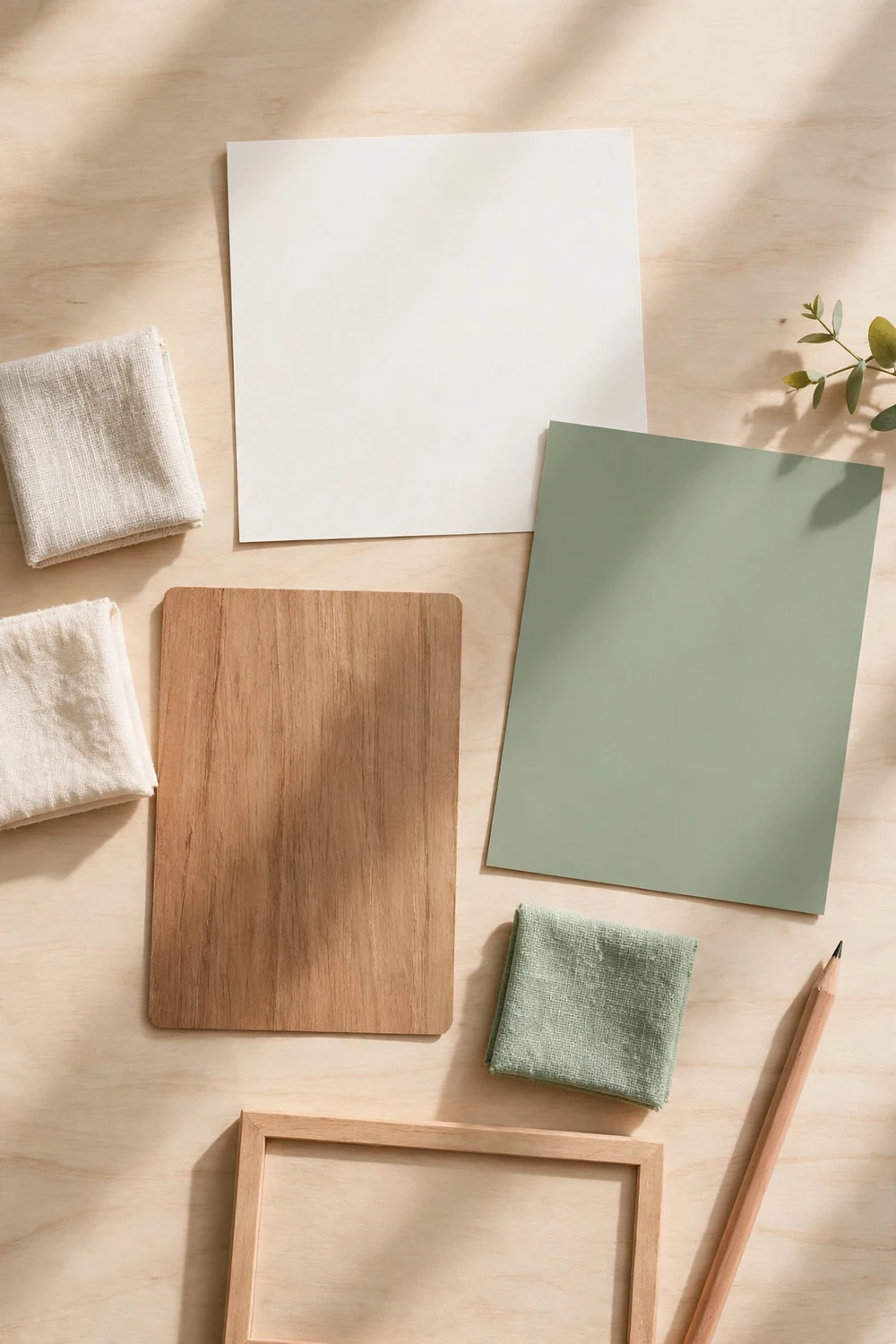
3. Pick one three colour palette and one style for the whole apartment
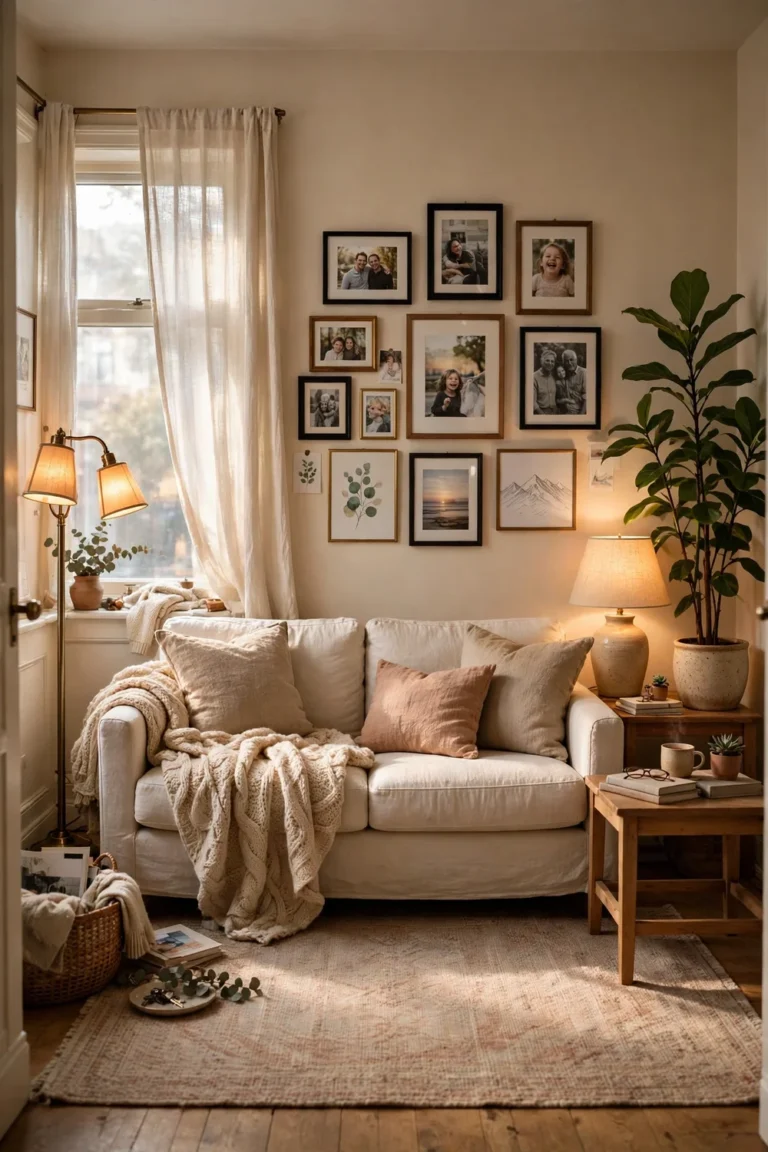
Cheap pieces look random. Cheap pieces in one palette look chosen. Pick three colours for the whole apartment and use them in every room: one main neutral, one warm tone and one accent. A palette that works in almost any small rental is warm white walls, natural wood and one accent, such as sage green, terracotta or dusty blue. Keep the accent to about one item in every five.
Pick one style to go with the palette and let it guide every buy. Scandinavian means pale wood, white and clean lines. Japandi means low furniture, warm neutrals and very little clutter. Warm neutral means cream, wood and soft texture everywhere. Boho means layered textiles and plants. The style matters less than the consistency: one style across the whole apartment makes budget pieces look like they belong together. Write the three colours and the style on a card for shopping trips.
Typically $0. Plan price $0. Running total $0.
Group 2: Light and scale
These three ideas are the highest impact cheap fixes in the whole plan. Light and scale decide how big a room feels.
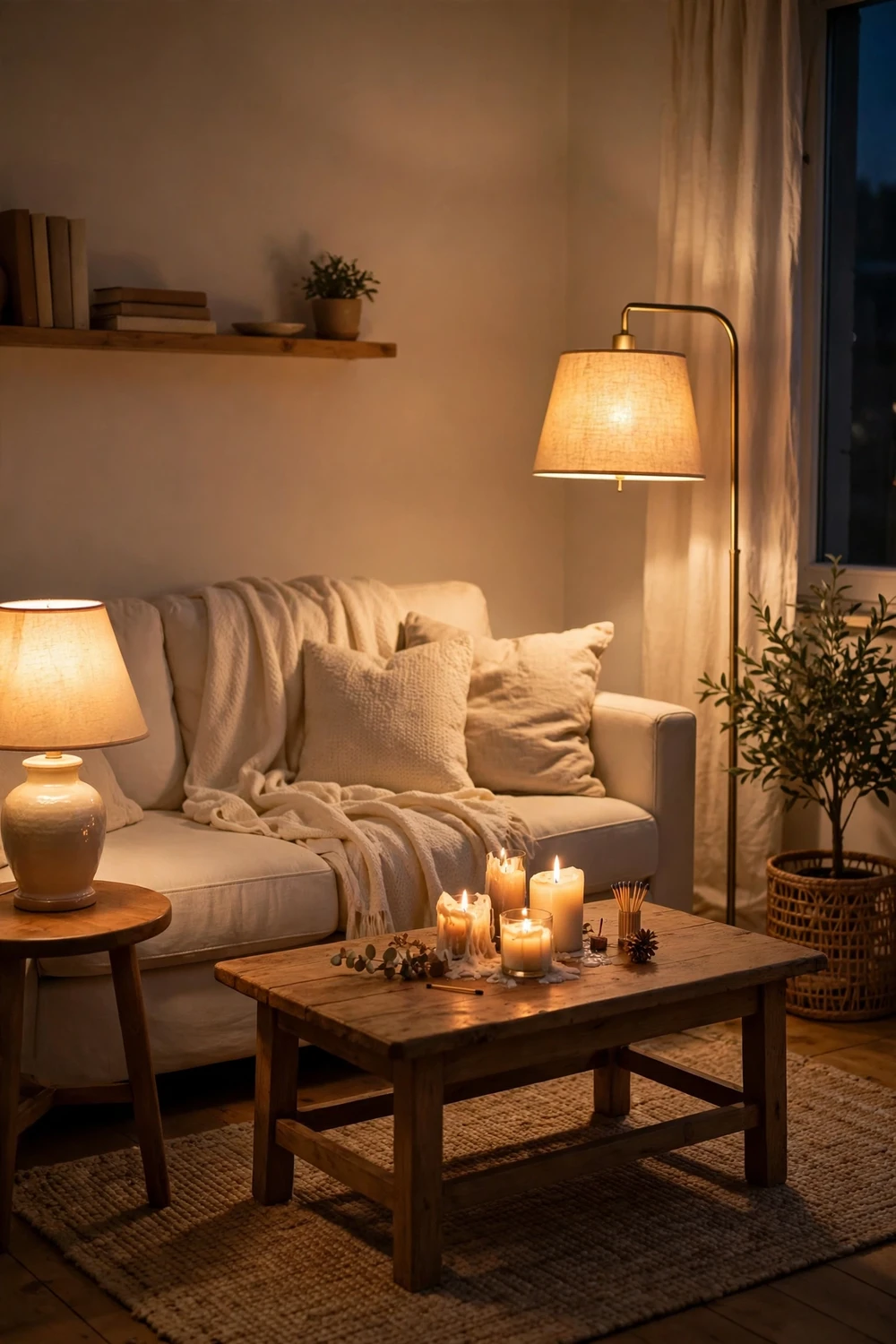
4. Swap bulbs to warm white 2700K and add low light
Most rentals come with cool white bulbs that make a room feel like an office. Swap them for warm white bulbs at 2700K, the warm glow you see in cafes and hotels, and the room softens at once. Warm light flatters wood, fabric and skin.
Then add low light. One ceiling light on its own flattens a room, so add light at sitting height: a floor lamp behind the sofa, a small table lamp on a shelf, or candles on the coffee table in the evening. Two or three small pools of warm light beat one bright ceiling light every time. Keep the bulbs the same warmth in every room.
Typically $10 to $18. Plan price $14. Running total $14.
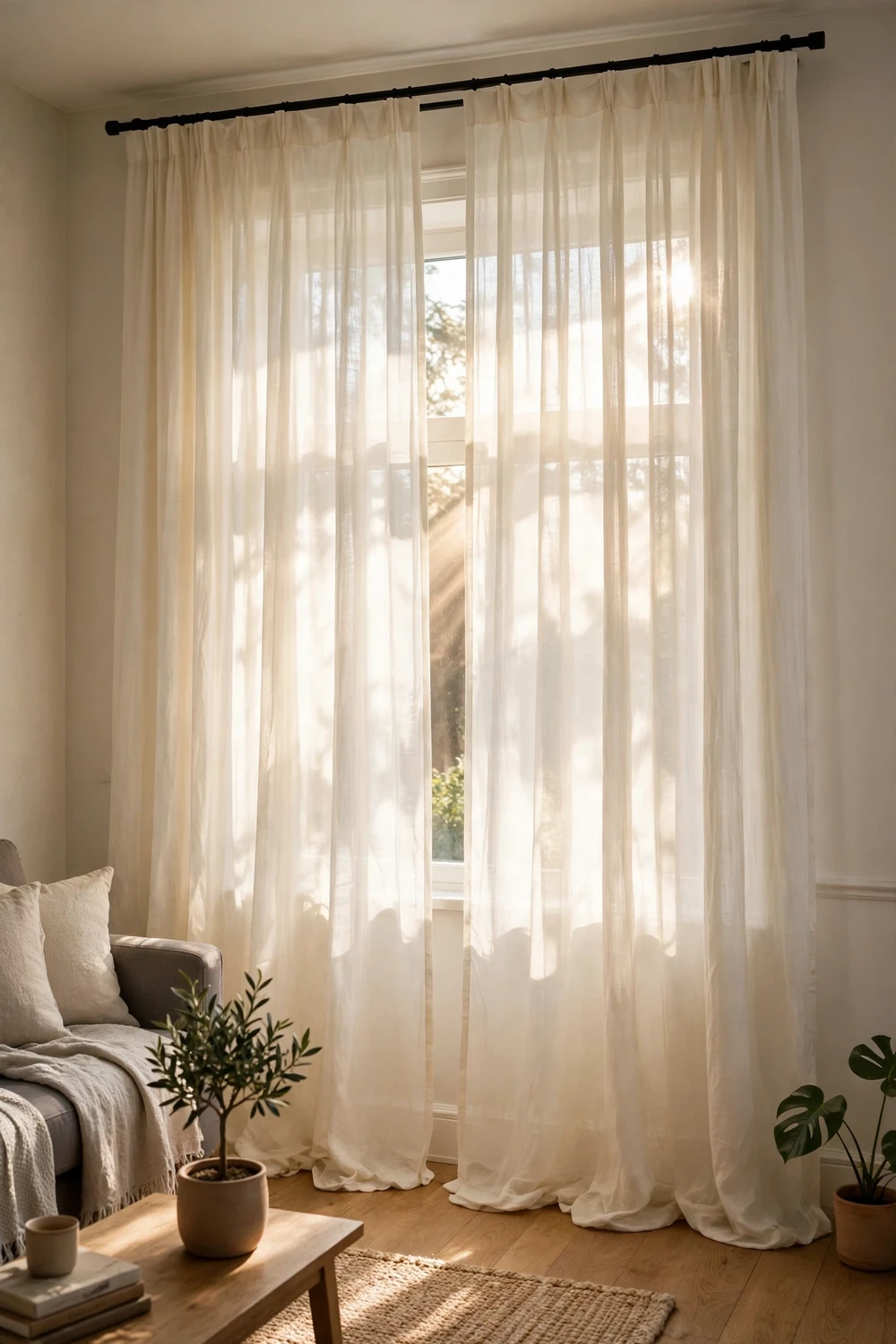
5. Hang curtains high and wide
Curtains hung at the window frame make a window look small. Hang the rod 10 to 15 cm above the frame and wider than the window, so the panels sit on the wall when they are open. Floor length panels in a light fabric make the wall look taller and the window look bigger.
Pick a colour from your three colour palette, usually the main neutral or the warm tone, and keep it plain. A plain curtain in the right colour looks more expensive than a patterned one in the wrong colour. If the rental has blinds you cannot remove, hang the curtains in front of them and leave the blinds open.
Typically $18 to $35. Plan price $26. Running total $40.
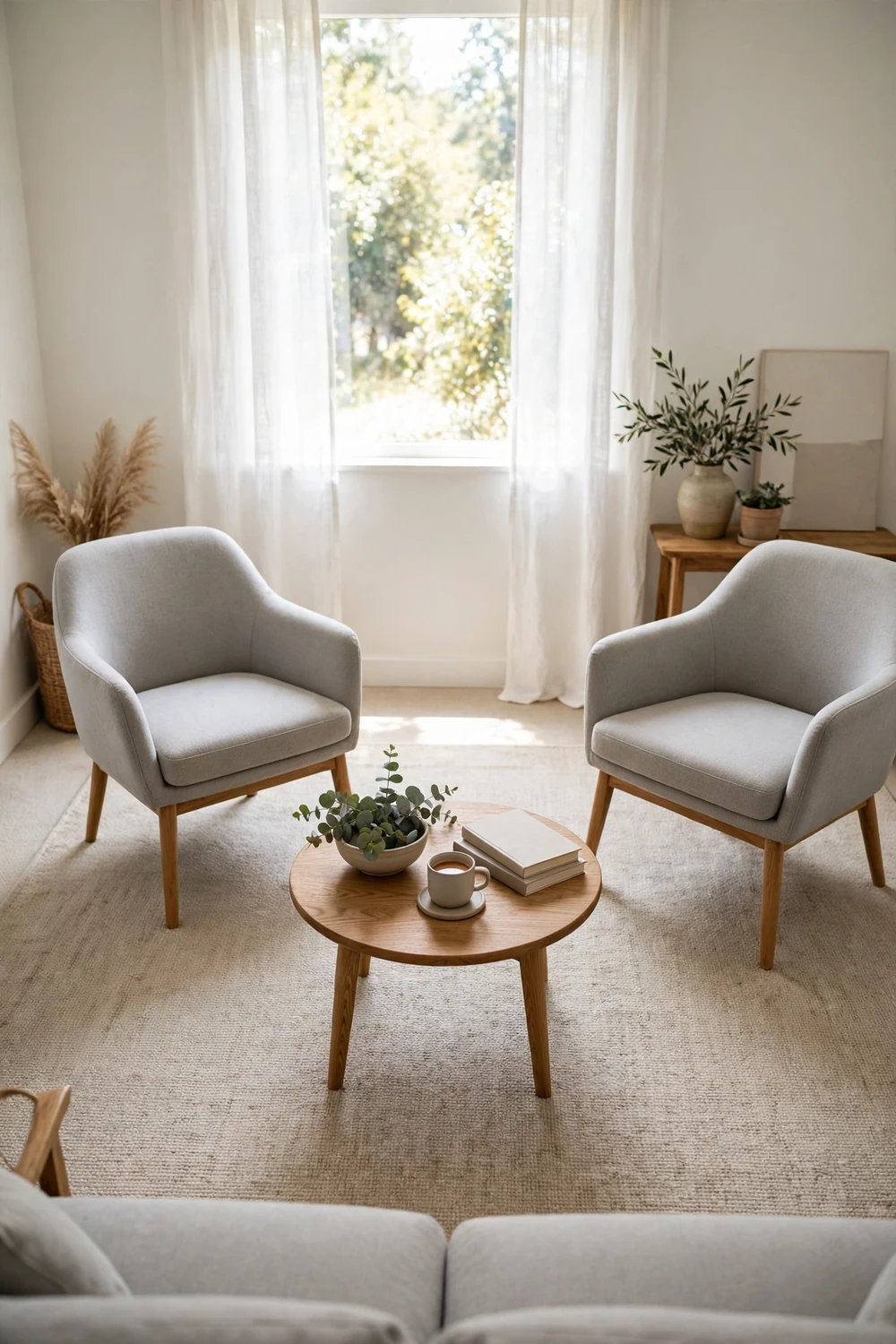
6. One rug big enough, with front legs on it
A rug that is too small is the most common mistake in small apartments. A small rug floating in the middle of the floor makes the room look smaller and the sofa look stranded. Buy one rug big enough that the front legs of the sofa and the chairs sit on it. That one rule sizes the rug for you: measure the seating area, add the depth of the front legs, and that is your rug size.
The rug does two jobs at once. It zones the sitting area, so the room reads as a living room even in an open plan, and it adds the largest block of colour and texture in the room. Pick a low pile rug in a neutral from your palette, with a subtle pattern if you like. A low pile rug is easier to clean in a rental and slides under doors without catching.
Typically $30 to $48. Plan price $39. Running total $79.
These three ideas are the expensive look rules in action. For the full set of ten, see our guide to cheap things that make a home look expensive.
Group 3: Walls without drilling
Rental walls do not need holes to look finished. These three ideas use leaning, sticking and framing, and all of them come down cleanly.
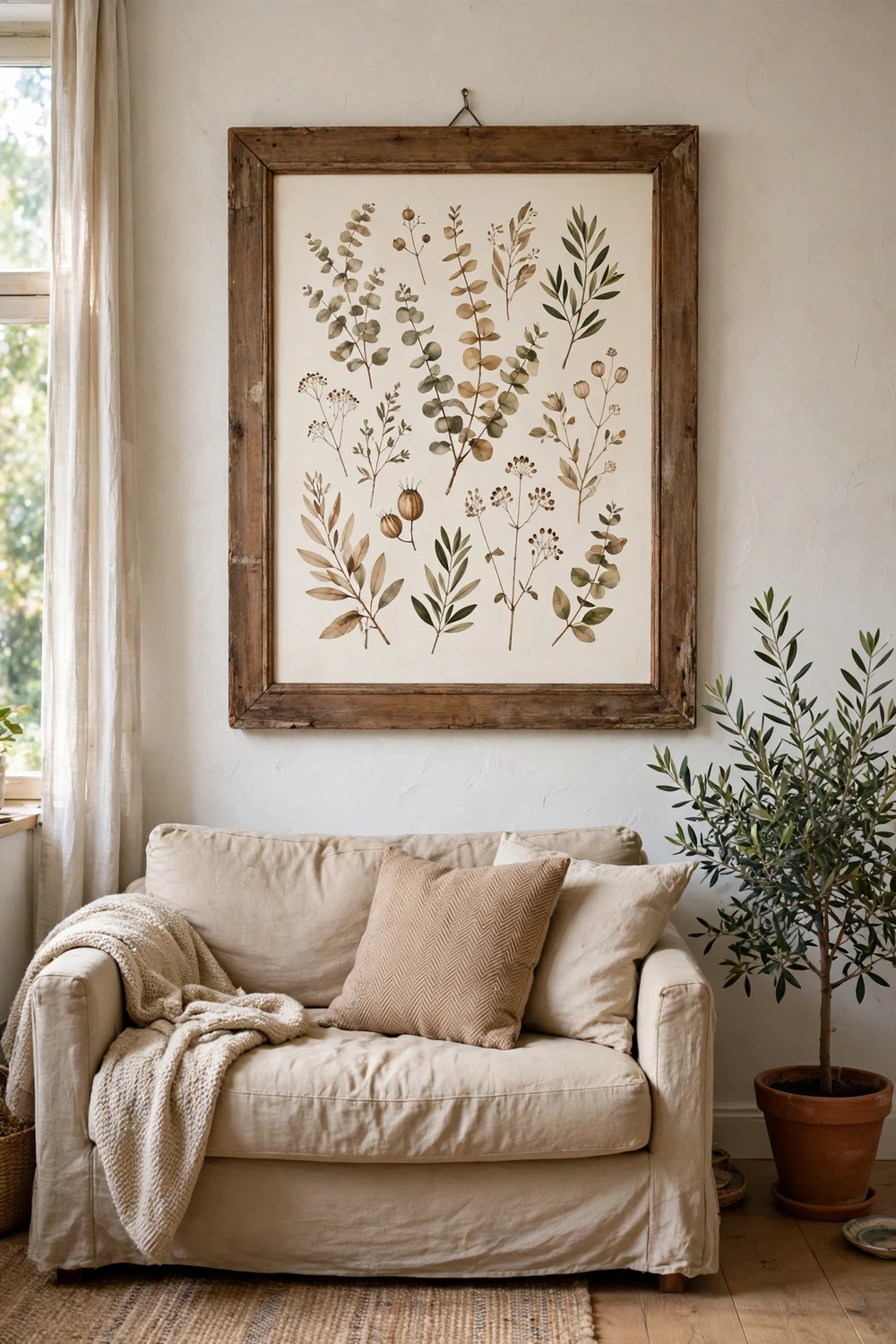
7. One large art piece in a thrifted frame
One large piece of art beats five small ones. Five small frames scattered on a wall read as clutter, while one large frame reads as a decision. Print a free art print at a copy shop, or use a calendar page or a fabric remnant, and put it in a large thrifted frame. A frame with a bit of wear looks fine once the glass is clean.
Hang it at eye level, with the centre of the piece about 145 cm from the floor, and give it space. If the wall is wide, one large piece still wins over a row of small ones, because the eye rests in one place. Keep the art inside your three colour palette so it ties the room together.
If you would rather make the art yourself, the DIY versions are in our DIY home decor on a budget guide.
Typically $8 to $20. Plan price $14. Running total $93.
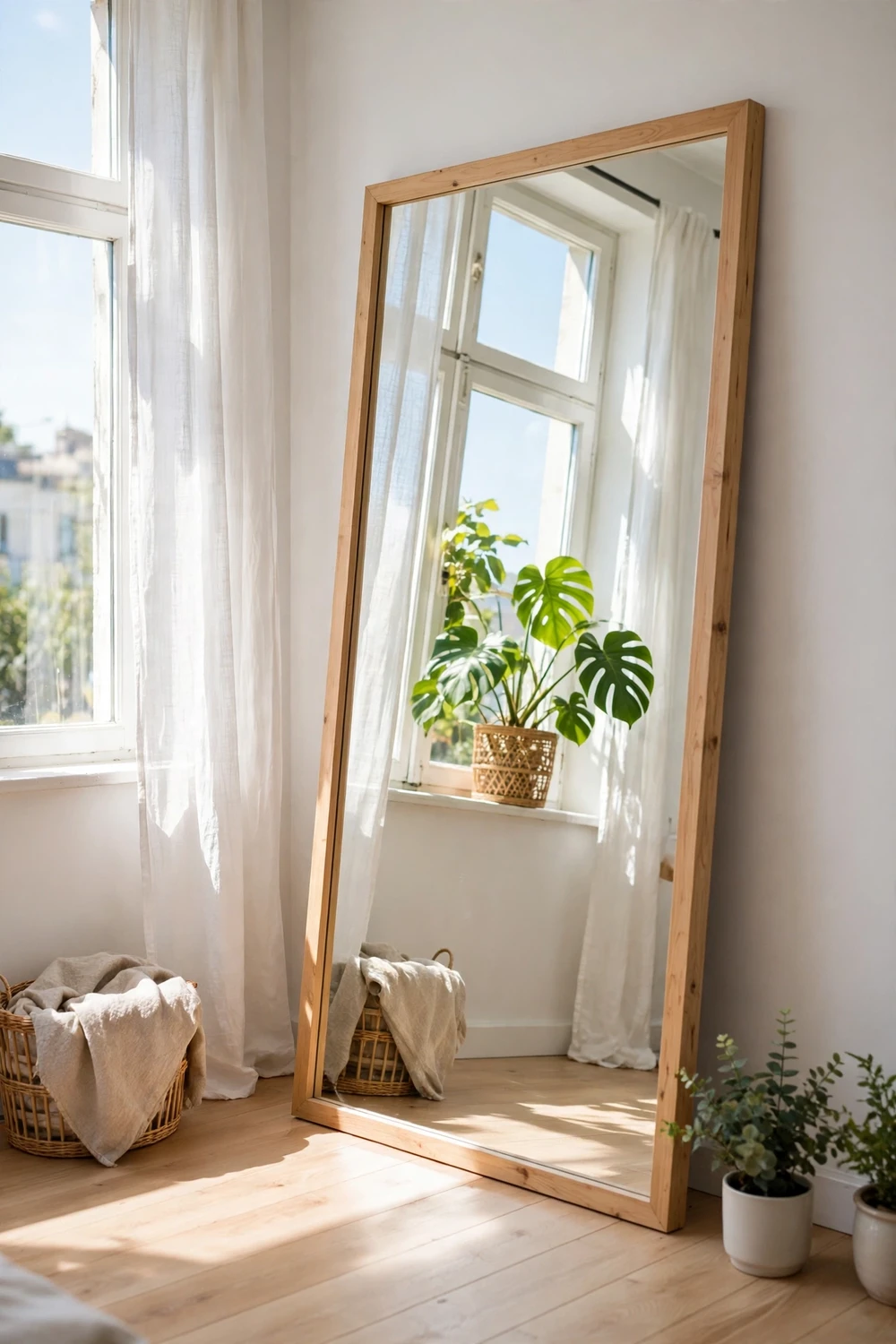
8. Lean a large mirror opposite the window
A large mirror opposite a window does three jobs: it bounces daylight across the room, it doubles the view, and it makes the room feel wider. Lean a full length mirror against the wall opposite the window and the whole room brightens. No drilling, no holes, and it moves with you.
Buy the largest mirror you can fit, because a small mirror over a sofa just reflects the ceiling. A thrifted mirror with a wood or plain frame is ideal, and a plain frame can be painted to match your palette. Check the reflection before you settle the spot: it should catch the window or a plant, not the cluttered side of the room.
Typically $25 to $45. Plan price $35. Running total $128.
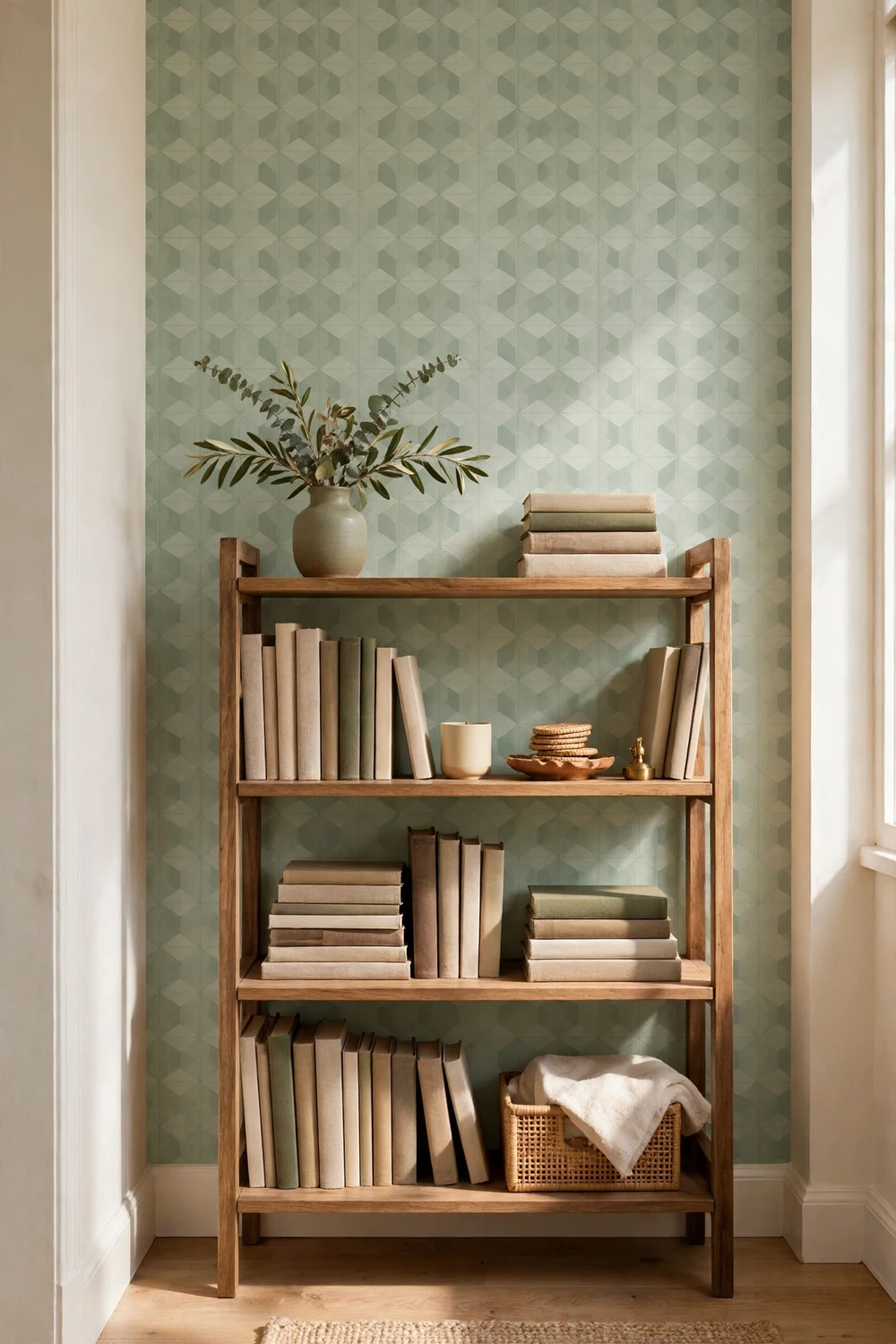
9. Peel and stick accent on one small area
Peel and stick paper is the renter friendly way to get a feature wall without paint. Use it on one small area only: the back of a bookcase, one narrow wall in the entryway, or the wall behind the bed. One small area with pattern makes the room feel designed, while a whole room in pattern feels busy and small.
Pick a subtle pattern in your palette, a soft stripe or a small geometric, and keep the rest of the room plain so the accent has room to breathe. Clean the surface first, work slowly from the top, and smooth out bubbles as you go. When you move, it peels off cleanly, which is the point. Keep a spare piece in case one edge lifts.
Typically $12 to $25. Plan price $18. Running total $146.
Group 4: Textiles and colour
Textiles are where a small apartment gets its warmth, and they are the cheapest way to change the colour of a room.
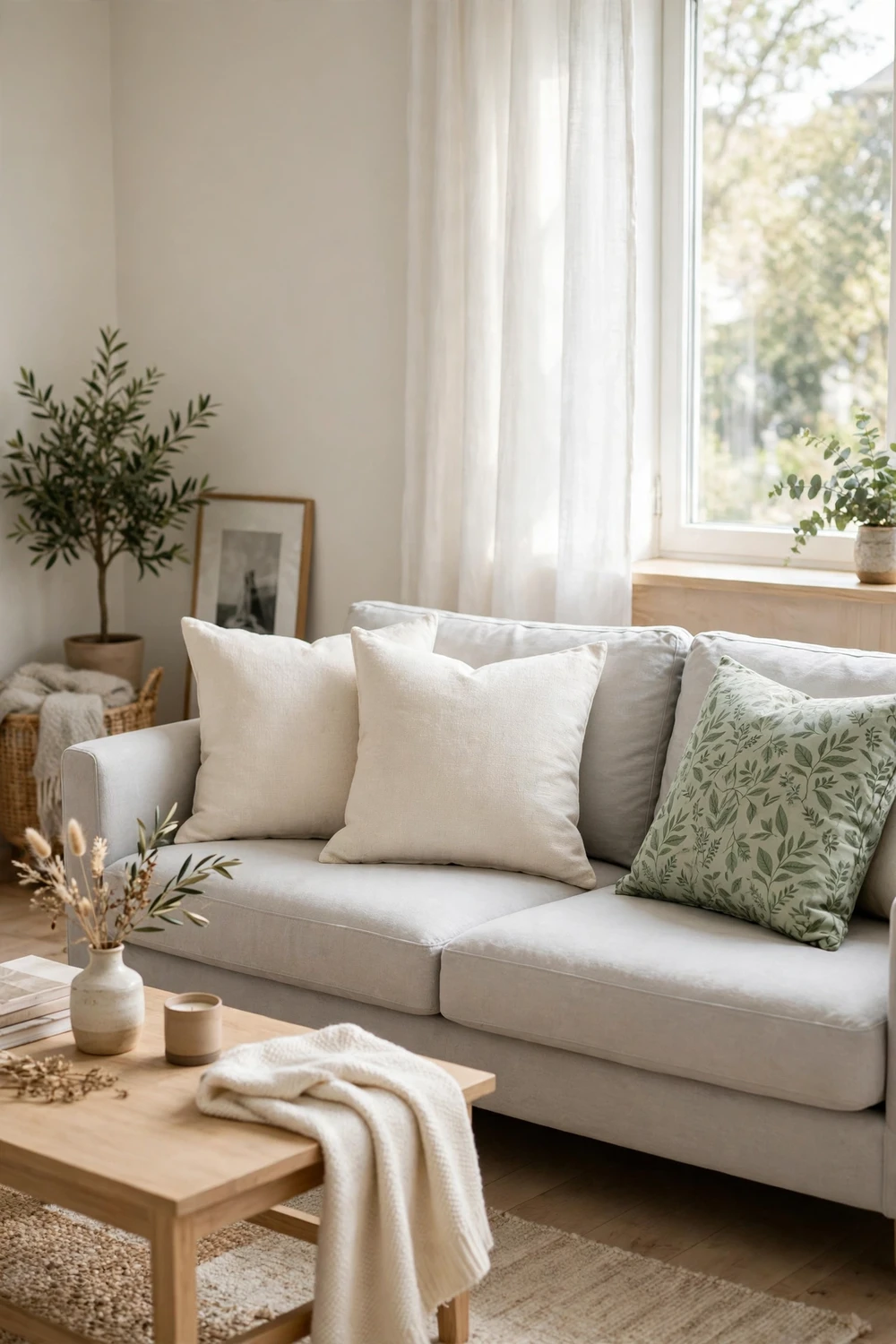
10. Cushion covers only, the 2+1 formula
Do not buy new cushions. Buy covers. A cover costs a fraction of a new cushion, and it is the cover that carries the colour. Use the 2+1 formula: two plain covers in your main neutral and warm tone, plus one patterned cover in your accent colour. Three covers change a whole sofa.
Buy inserts two inches larger than the cover, so the cushion looks full instead of flat. A 45 cm cover wants a 50 cm insert. Fluff the corners out after you put the cover on. Wash the covers before the first use, because new fabric softens and the colour settles.
Typically $12 to $24. Plan price $18. Running total $164.
11. Layer three textures per room
A room with one texture looks flat, however good the colours are. A room with three textures looks rich, even when everything in it was cheap. Layer one soft texture, one natural texture and one woven texture in every room: a boucle throw, a linen cushion, and a jute rug or rattan basket. They do not need to match, they need to contrast gently.
Put the textures where hands land: a throw over the arm of the sofa, a linen cushion where you sit, a woven basket by the door. Keep the colours inside your palette so the textures add depth without adding noise. If a room still feels cold after the light and the rug are sorted, it is almost always missing a texture, not a new piece of furniture.
Typically $15 to $30. Plan price $22. Running total $186.
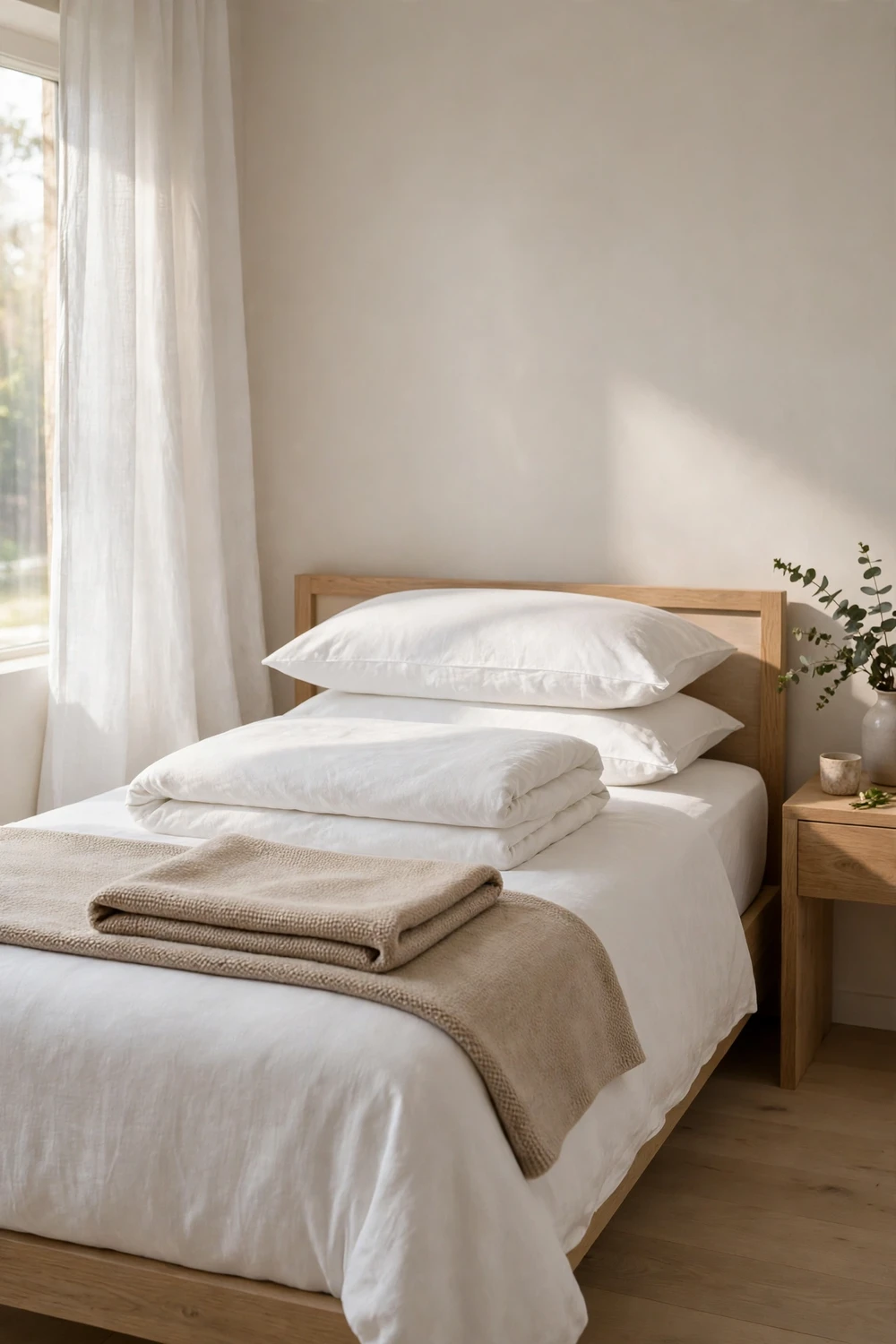
12. Hotel style bed plus one duvet cover spend
The bed is the largest thing in the bedroom, so it sets the whole room. Making it properly every morning costs nothing and changes the room more than any purchase: pull the sheet tight, plump the pillows, and fold the duvet back a third. A made bed makes the rest of the room look tidy.
Then spend once on a duvet cover in your palette, in white, cream or the warm tone from your three colours. One good cover in the right colour lifts the whole bedroom, and it washes well, so it is the one textile worth spending a little more on. Keep the sheets plain and let the cover carry the colour.
Typically $20 to $40. Plan price $30. Running total $216.
Group 5: Furniture that earns its place
In a small apartment every piece of furniture must earn its floor space.
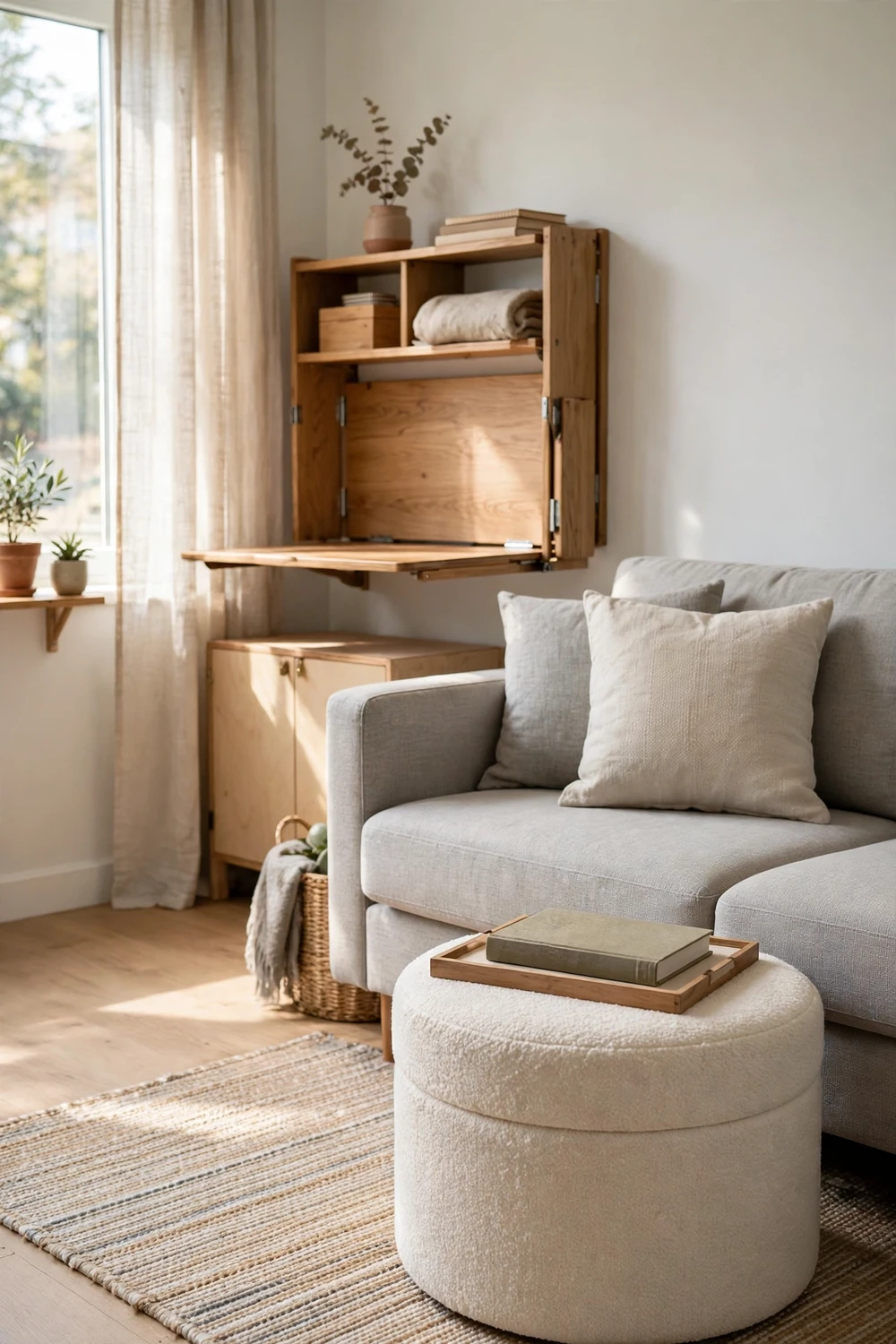
13. One multifunctional piece
Buy one piece that does two jobs, and let it replace two things you were about to buy. A storage ottoman is a footrest, a coffee table with a tray on top, and a box for throws and games. A sofa bed is a sofa by day and a guest bed by night. A fold down table on the wall is a desk by day and clear floor space by night.
Pick the piece that solves your biggest daily problem, not the one that looks best in a photo. If the flat has nowhere to store throws and games, buy the ottoman. If friends stay over, buy the sofa bed. If you work from home at the kitchen table, buy the fold down desk.
Typically $30 to $48. Plan price $39. Running total $255.
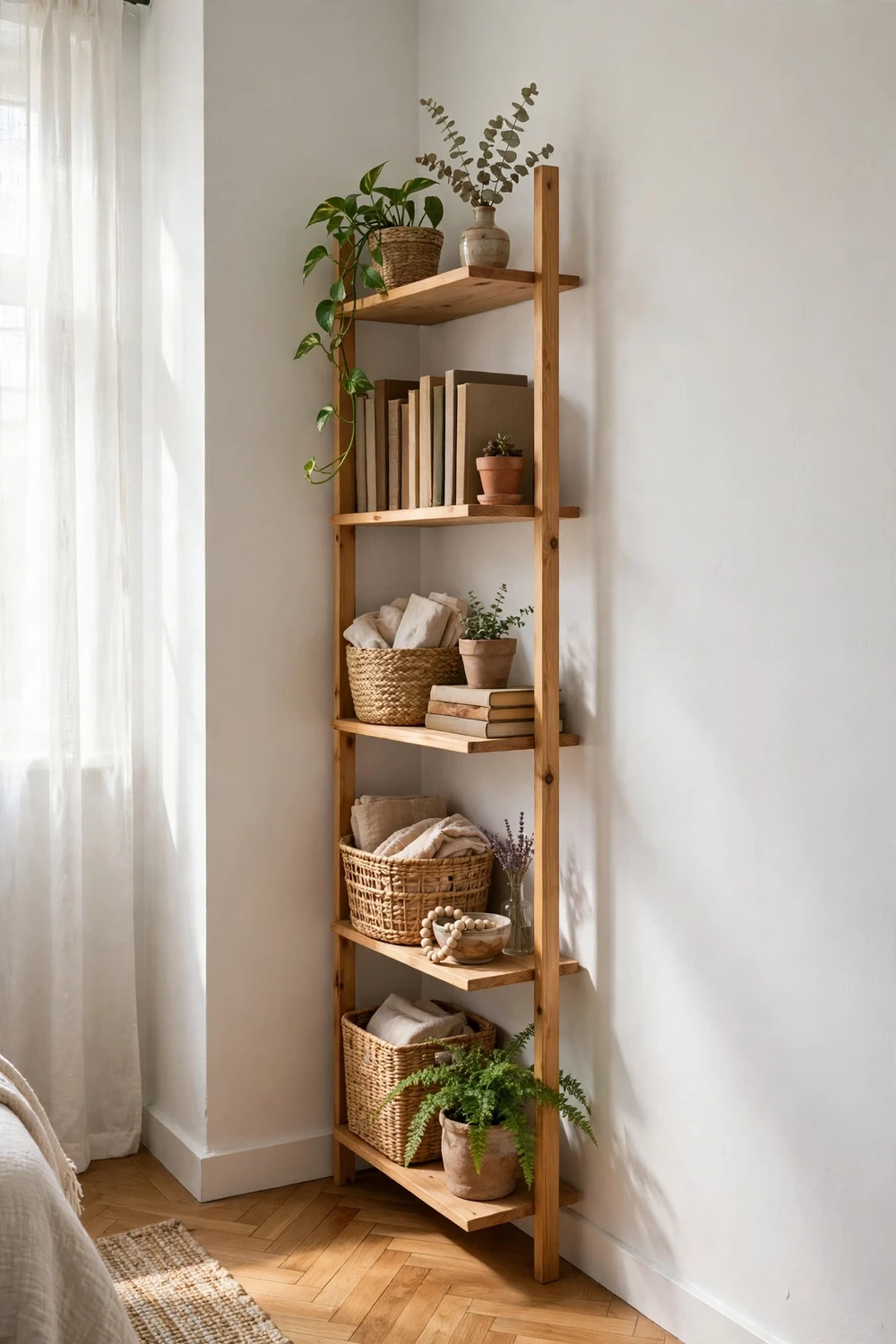
14. Go vertical with tall narrow shelves and over door storage
Small apartments run out of floor long before they run out of wall. Go vertical: one tall narrow shelf holds more than two short wide ones and takes up less floor. Put the shelf where the wall is empty, and keep the top shelves for things you use rarely and the middle shelves for things you use daily.
Use the backs of doors too. Over door hooks in the bedroom hold bags and jackets, and an over door rack in the bathroom holds towels. Keep the vertical storage inside your palette, with matching baskets or boxes. Leave some shelves half empty: a shelf packed tight looks like a cupboard, while a shelf with breathing room looks like a display.
Typically $20 to $40. Plan price $30. Running total $285.
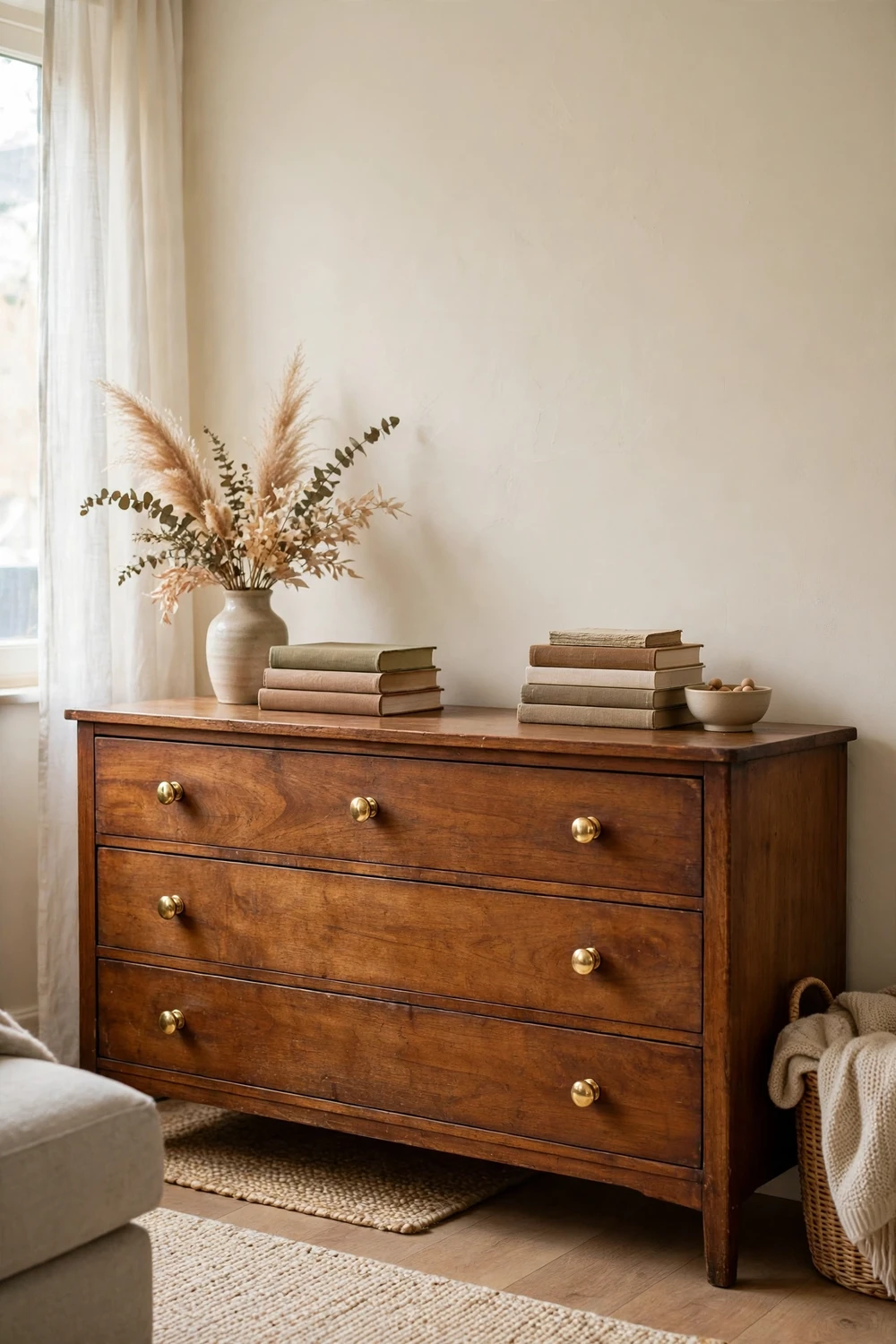
15. One thrifted wood anchor plus a hardware swap
Every small apartment needs one piece of real wood. Wood warms up a rental in a way that flat pack white furniture never does, and a thrifted wooden sideboard, dresser or small table is often the cheapest solid piece you will find. Look for solid wood with good bones: drawers that slide, doors that close, and a flat top. Scratches and dull finish are fine, because that is what makes it cheap.
Then swap the hardware. New knobs or handles in one matching finish, brass, black or wood, cost very little and make a tired piece look deliberate. Keep the original hardware in a labelled bag so you can put it back. Clean the wood, oil it if it is dry, and let it be the anchor the room sits around.
Typically $25 to $45. Plan price $35. Running total $320.
Group 6: Room by room finish
The last three ideas finish one room each: the kitchen, the bathroom and the entryway.
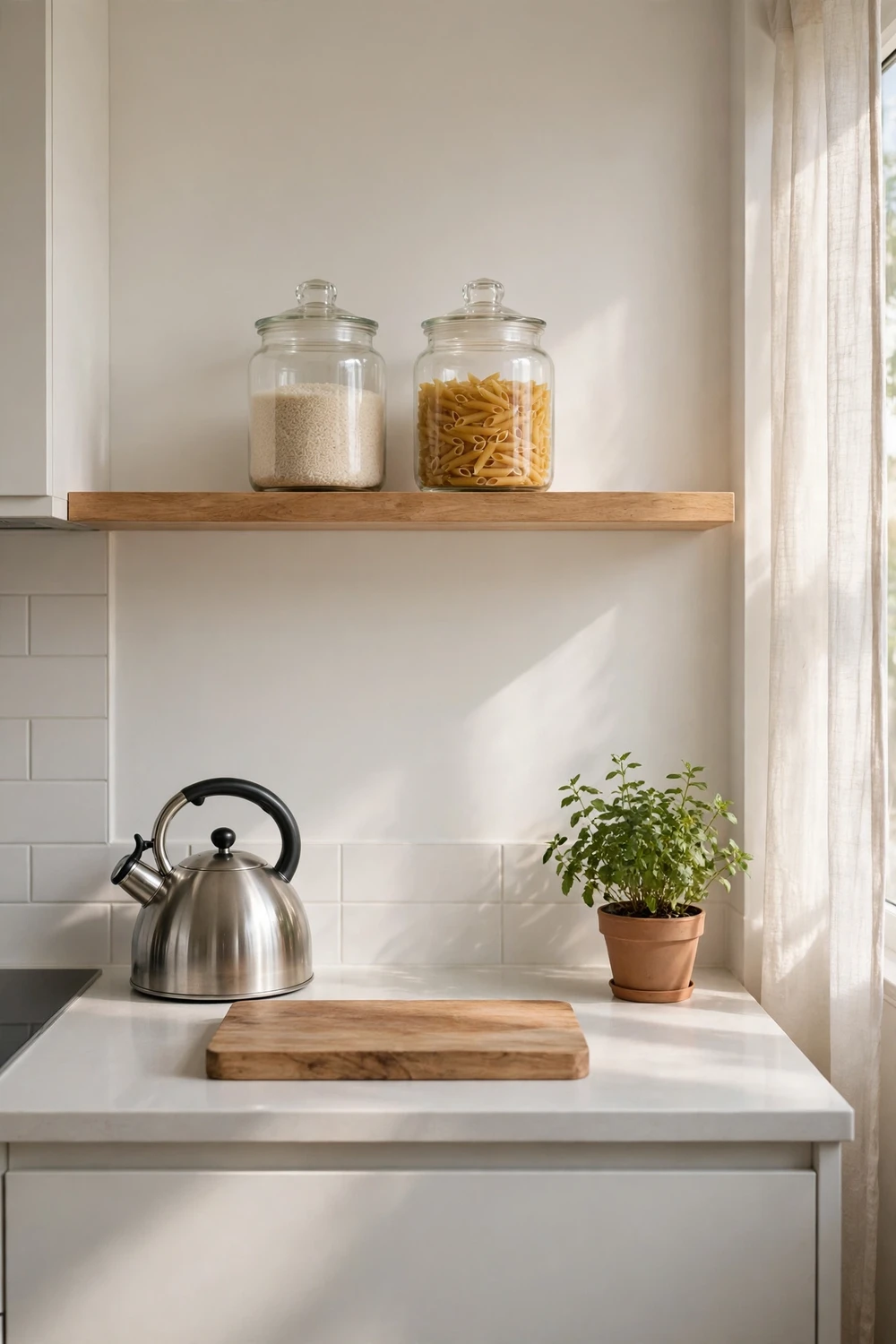
16. Kitchen: clear counters to three things, plus decanting
Kitchen counters collect everything, and a crowded counter makes the whole apartment feel messy. Clear the counters down to three things: the kettle or coffee maker, a chopping board, and one living thing, a plant or a bowl of fruit. Everything else goes in a cupboard.
Then decant the dry goods. Pour rice, pasta, oats and flour into matching glass jars and the open shelf suddenly looks styled instead of stored. Matching jars cost very little at a discount store. Keep the jars plain, and let the colours of the food be the only colour on the shelf.
Typically $8 to $18. Plan price $13. Running total $333.
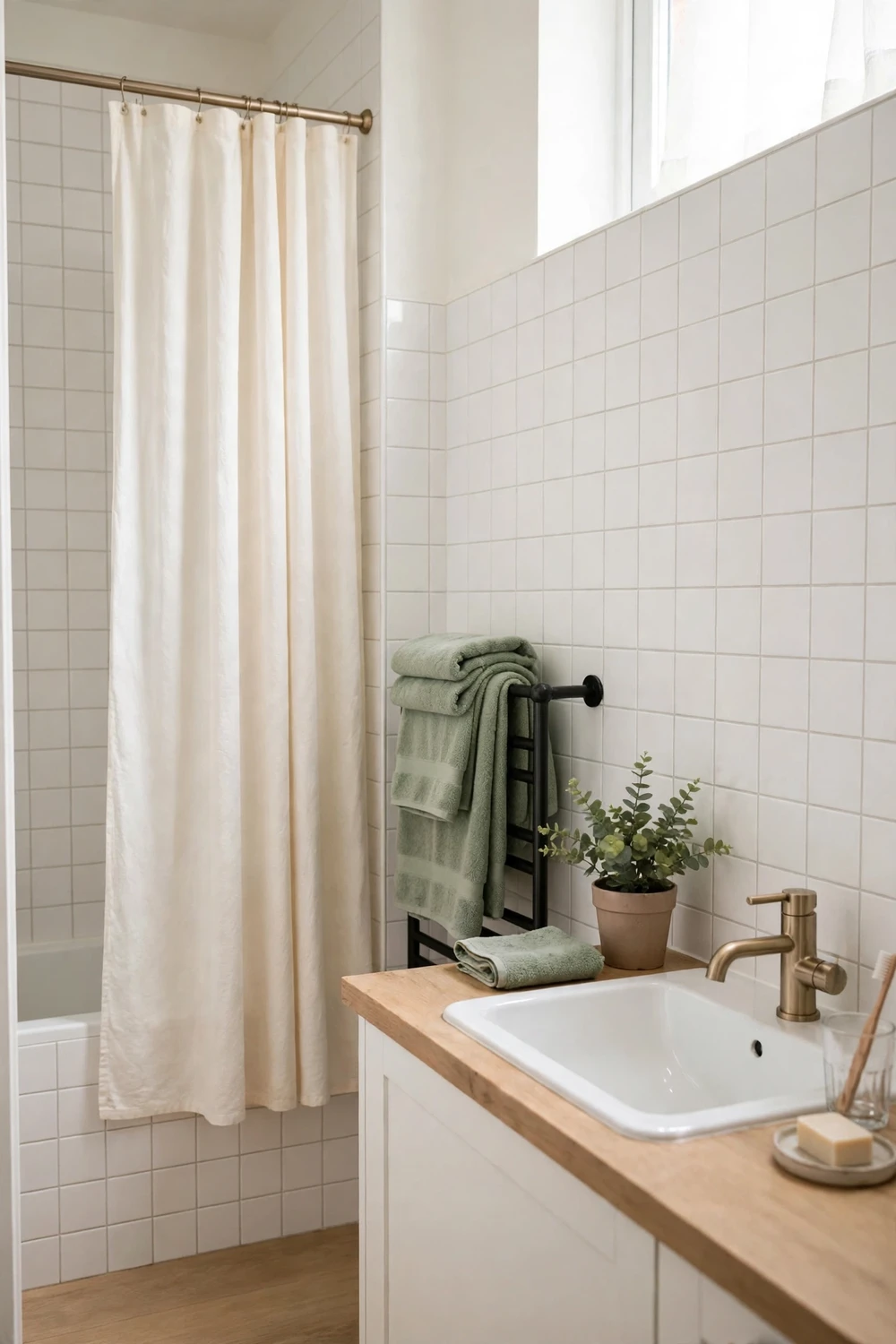
17. Bathroom: shower curtain and towels as the wall
The shower curtain is the largest surface in a small bathroom, so it is the wall. A new curtain in your palette, plain or with a subtle pattern, changes the whole room for the price of a lunch. Hang it high and let it fall straight.
Match the towels to the curtain and the room is finished. Two bath towels and two hand towels in the same colour, folded neatly and hung straight, do more than any accessory. Roll the spare towels in a basket if there is no shelf, and keep the counter to three things, just like the kitchen. A bathroom with a good curtain, matching towels and a clear counter feels like a hotel bathroom, even in a rental.
Typically $15 to $30. Plan price $22. Running total $355.
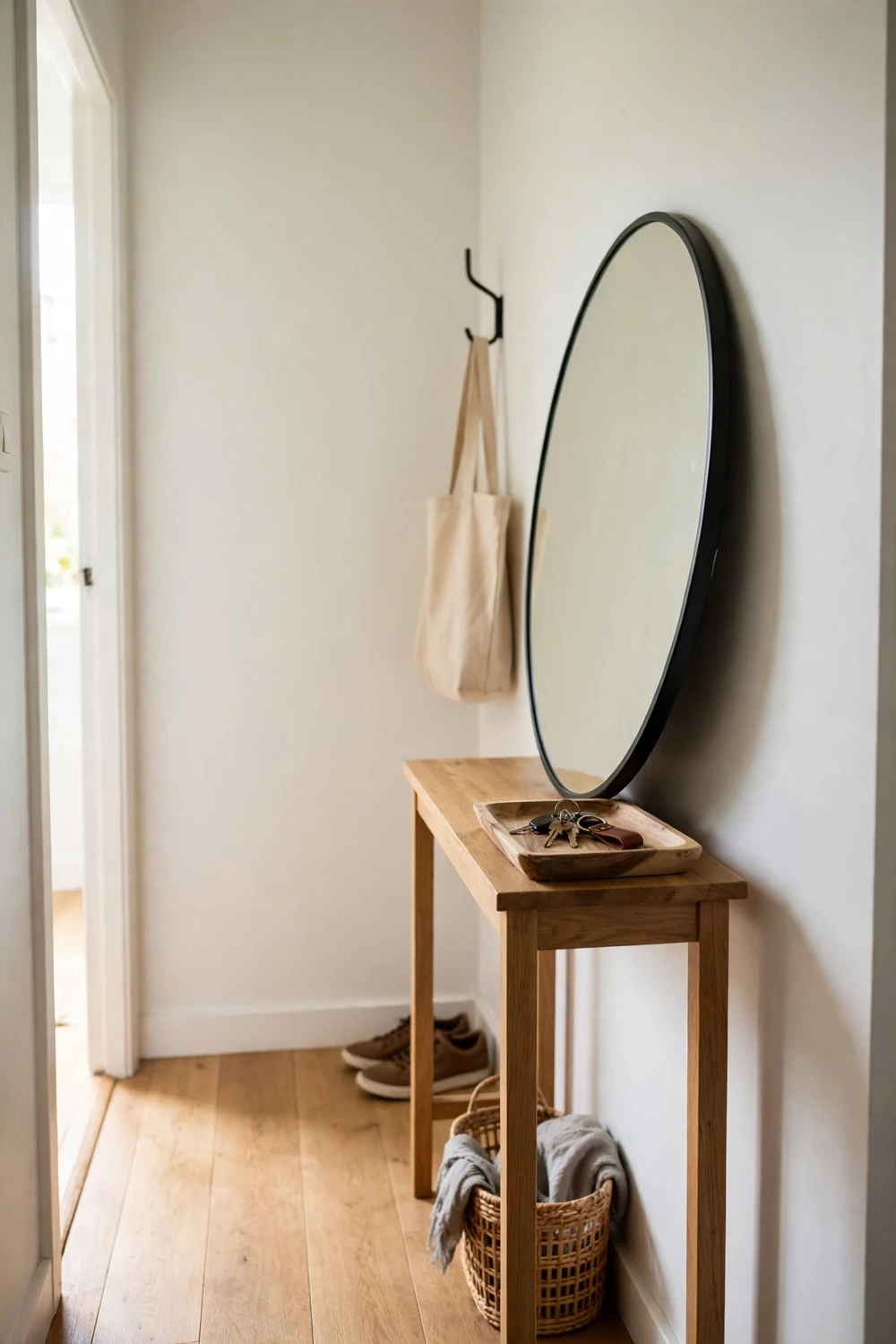
18. Entryway: lean mirror and tray drop zone
The entryway is the first thing you see when you come home and the last thing you see when you leave, so it deserves one finished idea. Lean a small mirror against the wall or hang one on a removable hook, put a tray underneath it for keys, and add one hook for a bag or a jacket. That is the whole drop zone.
Keep it to those three things. A console table, a bench, a basket and a shelf all fighting for the same square metre is how entryways become dumping grounds. One tray for keys, one hook for the bag, and a mirror to check yourself on the way out is enough.
For 25 entryway only ideas that go deeper on this room, see our entryway decor ideas on a budget.
Typically $12 to $25. Plan price $18. Running total $373.
Where to shop, by store
Different stores are cheap for different things. Shop each store for what it does best, and do not buy everything in one place.
| Store | Best buys there |
|---|---|
| Thrift stores and Goodwill | Wood furniture, frames, mirrors, vases, lamps |
| Facebook Marketplace | Rugs, mirrors, multifunctional furniture, lamps |
| IKEA | Curtains, rugs, shelves, cushion covers, storage boxes |
| Target | Cushion covers, duvet covers, shower curtains, towels, small decor |
| Dollar Tree | Vases, candles, small frames, decanting jars, baskets |
| Amazon | Warm white bulbs, peel and stick, curtain rods, hardware, removable hooks |
A few shopping rules keep the budget honest. Check the thrift store and Marketplace first for the big pieces, because those are where the savings are biggest. Buy the new things, bulbs, covers and curtains, from the budget stores. Measure before you leave the house. And buy the boring things first: bulbs, rods, hooks and jars are not exciting, but the pretty things look wrong without them.
Your first week: the 7 day plan
A plan with dates gets done. A plan without dates becomes a wish list. Here is the week, tied to the budget tiers.
Day 1, Friday evening: ideas 1 to 3. Measure, tape the layout, declutter, rearrange, and pick your three colours and your style. Cost: $0.
Day 2, Saturday morning: shop the $150 tier. Buy the bulbs, the curtains, the rug, the frame and art, the mirror and the peel and stick.
Day 3, Saturday afternoon: ideas 4 to 6. Swap the bulbs, hang the curtains, and lay the rug. The room changes today.
Day 4, Sunday: ideas 7 to 9. Frame the art, lean the mirror opposite the window, and put the peel and stick on its one small area.
Day 5, Monday evening: ideas 10 to 12. Change the cushion covers, layer the three textures, and make the bed hotel style.
Day 6, Tuesday evening: ideas 13 to 15. Bring in the multifunctional piece, put up the tall shelves, and place the wood anchor.
Day 7, Wednesday evening: ideas 16 to 18. Clear the kitchen counters, change the shower curtain and towels, and set up the entryway drop zone.
Then live with it for a week before you spend the next tier. You will find one thing that needs moving and one thing you do not need at all.
Mistakes to avoid, and what each one costs
A rug that is too small. The cost is a new rug, typically $30 to $48, plus the first rug you cannot use. Measure the seating area and buy for the front legs.
Too many tiny pieces. Ten small pieces at typically $5 each is $50, and the room still looks unfinished. One large piece always beats five small ones, in art, in mirrors and in decor.
Pushing everything against the wall. The cost is free to fix, but it makes the room feel smaller and wastes the middle of the room. Float the sofa, even a little.
Dark colours in a small room. The cost is new cushion covers or a lighter rug, typically $20 to $40, to lift the room again. Keep the big surfaces light.
Oversized furniture. The cost is a whole tier of budget in a single buy. One oversized sofa can eat the entire $150 tier. Measure first, buy second.
Cool white lighting. The cost is a new set of warm bulbs, typically $10 to $18. Warm white at 2700K is the cheapest atmosphere you can buy.
Deposit safe move out checklist
Everything in this plan is renter friendly, but a checklist makes the move out painless.
- Photograph every wall, floor and fixture on move in day, and keep the photos.
- Keep the original hardware in a labelled bag, and put it back before you leave.
- Use removable hooks and strips only, and test one in a hidden spot first.
- Keep the original shower curtain, knobs and light shades if you swap them.
- Fill any small holes and touch up marks before the final inspection.
- Keep receipts for anything the landlord supplied or approved.
- Take your peel and stick, mirrors and art with you. They are yours, and they will make the next apartment cheaper to decorate.
Frequently asked questions
How can I decorate a small apartment on a budget?
Start with the free ideas: measure, tape the layout, declutter and rearrange. Then pick a total, $150, $300 or $500, and buy in the order in this plan. A plan with a running total beats a long shopping list every time.
How much should I budget for decorating a small apartment?
Other guides put a small apartment decorating budget at $200 to $1,000, with under $50 per item as a common cap. This plan uses three tiers, $150, $300 and $500.
What is the cheapest way to decorate an apartment?
Rearrange what you own, buy thrifted decor, print free art for a thrifted frame, and add plants. The free ideas in this plan cost nothing and do more than any purchase.
How can I decorate without damaging the walls or drilling?
Use adhesive hooks, removable wallpaper and peel and stick, tension rods for curtains, and leaning mirrors and art. Everything in the walls group of this plan comes down cleanly.
What colours make a small apartment look bigger?
Light, low contrast colours in two or three shades. A main neutral, a warm tone and one accent, used in every room, makes a small apartment feel larger and calmer.
What furniture works best in a small apartment on a budget?
Multifunctional and foldable furniture: a storage ottoman, a bed with drawers, a fold down desk and a sofa bed. One piece that does two jobs saves more space than small storage.
How do I make a small apartment look expensive on a budget?
Keep the colours cohesive, use warm layered lighting, match the hardware, and keep clutter low.
Where is the best place to shop for cheap apartment decor?
Facebook Marketplace, OfferUp and Craigslist for large pieces, Goodwill and thrift stores for wood furniture and frames, and budget stores for new textiles and bulbs.
Are mirrors actually useful in tiny apartments?
Yes. One large mirror near natural light can visually expand a room. Lean it opposite the window so it bounces daylight across the room.
What are the biggest mistakes when decorating a small apartment on a budget?
Oversized furniture, pushing everything against the wall, ignoring vertical space, buying too many tiny pieces, and poor lighting. All six are covered above, with the cost of each one.
Start with the free three
Take the order: do the three free ideas first, then spend $150 on light, scale and walls, then $300 on textiles and furniture, then $500 on the full plan with extras. A small apartment does not need a big budget. It needs a plan, a palette and the discipline to buy in order. Pick your total and start tonight.


One Comment